
Insights · · Updated
Hydrogeochemistry for source questions: lines of evidence that hold
Hydrogeochemistry helps on source questions only when the chemistry is read with the geology and the flow system. Ratios, daughter products, and redox patterns are lines of evidence. They are rarely, by themselves, an identification of who released what.
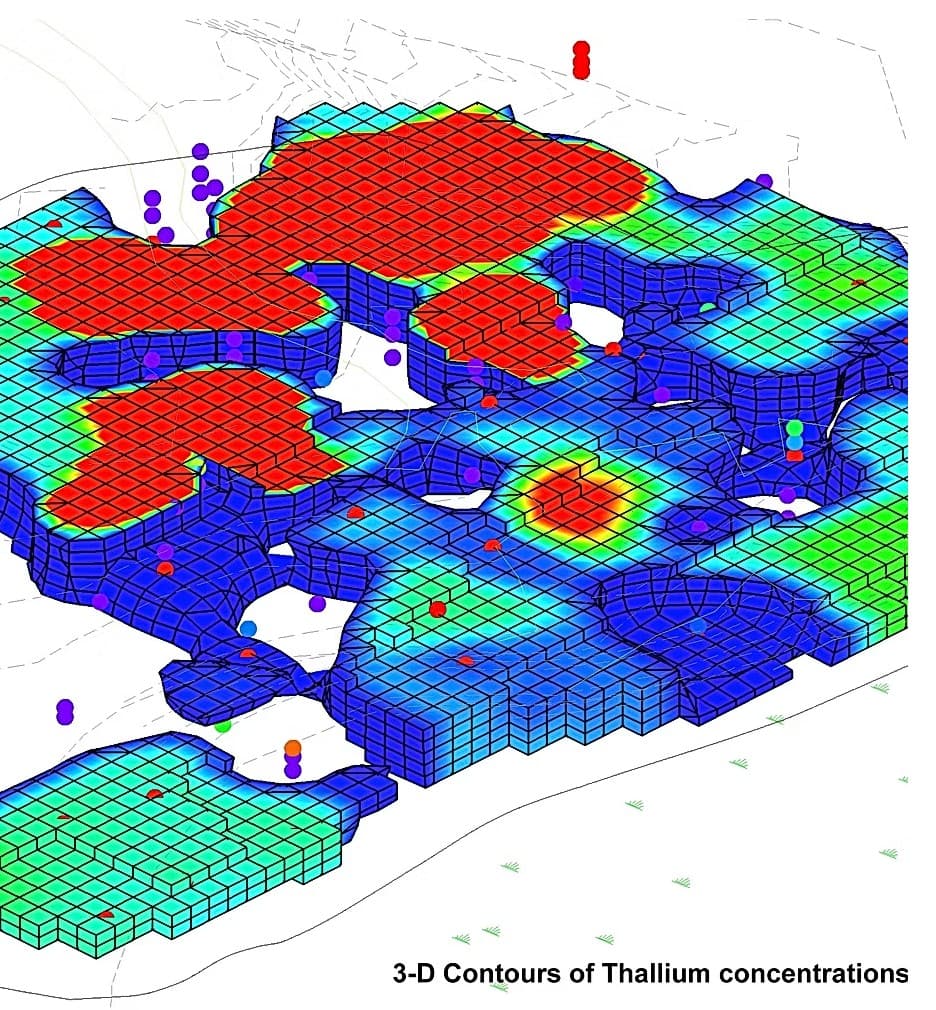
Concentration maps are not a source opinion
A hotspot shows where mass is now, or where a well happened to be screened. It does not, on its own, identify the release, the date, or the share. Stratigraphy, gradients, and the operations history decide which chemical patterns are meaningful. A plume drawn across a continuous clay, or through a well completed in fill, is a drafting choice until those constraints are on the figure.
We treat that pairing as the job of hydrogeochemistry: constituent trends and ratios in redox and geologic context, aimed at sources, commingling, and whether attenuation is plausible.
Lines of evidence that can converge
The stronger analyses look for agreement among independent lines. Degradation sequences—for example chlorinated ethene parent and daughter compounds—say something about process, not automatically about a single source. Molar ratios help when end members are distinct and mixing is the hypothesis you are testing. Spatial patterns should line up with hydraulic barriers or connections you can defend from the logs. Temporal patterns should line up with operational changes, not with a preferred narrative.
Redox indicators (dissolved oxygen, nitrate, iron, sulfate, methane, where they were analyzed) constrain whether a degradation story is even available in that portion of the aquifer. A daughter product in an aerobic, fast-flow zone needs a different explanation than the same compound in a reduced, low-permeability interval.
Commingled plumes
Commingling means more than one contribution is plausible in the same water-bearing zone. The honest product is often a map of where the lines agree, where they conflict, and where the data cannot separate the sources. Allocation percentages that outrun that map do not survive scrutiny.
Isotopes and other specialized analyses earn their cost when the end members are expected to differ and the sampling can hit them. They are not a default add-on. If the wells do not represent the end members, a sophisticated method still returns an ambiguous result. Forensic geology is what tells you whether those wells are in the units you think they are in.
Graphics a trier of fact can audit
Use a few plots, each tied to one inference, with the non-detects and the detection limits visible. A cross-plot without the map, or a map without the screen intervals, invites over-reading. The caption should say what the figure supports and what it does not.
That discipline is the same one we use in litigation support: a testable narrative, bounded language, and no chemical fingerprint claim the data cannot carry.
Questions counsel ask
- Can groundwater chemistry alone prove a source?
- Rarely. Strong opinions combine chemistry with release history, geology, hydrogeology, and the operations record. A single ratio or chromatogram is a clue, not an identification.
- What is a commingled groundwater plume?
- A plume in which more than one release or source area may contribute mass to the same water-bearing zone. The technical task is to show where the lines of evidence separate those contributions and where they cannot.
- When are isotope analyses worth collecting?
- When the candidate sources should have different isotopic signatures and the wells can sample those end members. If the well network mixes units, the laboratory method will not repair the field design.
Daniel S. Fisher, P.G.
Owner and principal hydrogeologist, Wetstone Solutions LLC. Pennsylvania professional geologist since 1994. This note is for education. It is not legal advice and not an opinion on any matter.
Related reading
- Hydrogeochemistry
- Forensic geology
- Environmental litigation support
- Forensic geology in environmental litigation