
Insights · · Updated
Groundwater modeling and admissibility: documentation that holds up
When a groundwater model is challenged, the fight is usually whether the method is reliable and whether the application fits the site—not whether the software is popular. Documentation that holds up shows the conceptual site model, the calibration targets, the sensitivity of the result, and the limits of what the run was allowed to prove.
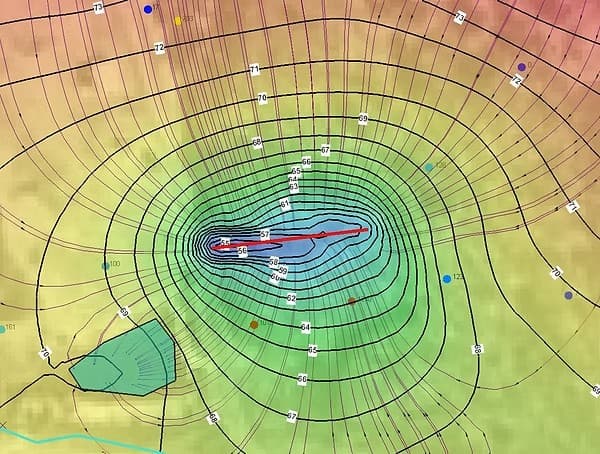
A model is a structured argument
Numerical groundwater models encode choices: which units are layers, which boundaries add or remove water, which parameters are measured, and which are adjusted until the heads look right. Those choices are the opinion. The contour map is the output.
Decision-makers ask three practical questions. Is the conceptual model consistent with the borings and tests? Were the predictions checked against observations that were not quietly used as knobs? Can someone else see which assumption moves the answer? In federal court the reliability question is often framed under Daubert and Rule 702; state courts use their own standards. This note is about the technical file, not the legal test. Our fate and transport modeling work is built to answer those questions in the report, not in a follow-up letter.
What actually gets scrutinized
Boundary conditions are a common failure. A specified-head boundary that supplies unlimited water, or a no-flow boundary placed where the site data show flow, will make a capture zone or a travel time look decided when it is an artifact. The report should include a water balance and a sentence on why each boundary is physically fair.
Parameter fields get the same treatment. Hydraulic conductivity zoned to match every local anomaly, with no tie to lithology or a pumping test, reads as curve-fitting. Literature values are acceptable when they are identified as literature values and the sensitivity case shows the range.
Calibration is a process, not a score
Name the targets. Say how they were weighted. Show residual maps, not only a root-mean-square error. A low error at the wells you adjusted the model to match is a weak claim. Hold-out heads, a later monitoring round, a pumping test, or a chemistry arrival that the flow model did not “see” are stronger checks.
Some mismatch is honest. Forcing a model to hit every well by breaking the geology is worse than a documented residual with a reason—well construction, a local lens, a bad measurement. Say so in the text. The longer checklist of what belongs in the file is in what a fate and transport report should show.
Sensitivity is how you answer “arbitrary”
If an opposing expert says the result was tuned, the response is a sensitivity run on the parameters that govern the opinion you are offering. Travel time is sensitive to effective porosity and retardation. Capture is sensitive to conductivity contrasts and to boundary heads. Plume length is sensitive to source mass and decay. Running a dozen cases that do not touch the disputed lever does not answer the criticism.
Counsel should ask for that run before the report is final. A model that is easy to audit is easier to explain, and easier to defend, because the expert is not inventing the rationale in deposition. That is the standard we use in hydrogeology expert witness assignments that turn on someone else’s model as well as our own.
Questions counsel ask
- What makes a groundwater model defensible?
- A conceptual site model tied to site data, boundary conditions that respect the water balance, calibration targets that are identified as targets, sensitivity on the assumptions that move the opinion, and input files a reviewer can open.
- Does a model have to match every monitoring well?
- No. A perfect match achieved by geologically implausible parameters is weaker than a documented residual. The report should explain the mismatch and whether it affects the opinion.
- Are analytical models scrutinized the same way?
- The same ideas apply: stated assumptions, parameters you can source, and a result that is not asked to outrun the method. A simple model with visible assumptions is often stronger than a grid built on guesses.
Daniel S. Fisher, P.G.
Owner and principal hydrogeologist, Wetstone Solutions LLC. Pennsylvania professional geologist since 1994. This note is for education. It is not legal advice and not an opinion on any matter.
Related reading
Request a conflict check →